
Call for Papers
CIUTI Conference 2026
Translation & Interpreting, AI, and the
Language Industry:
Research and Professional Practice
19-20 May 2026
IULM University, Milan (Italy)
CALL FOR PAPERS
Extended submission deadline: 16 March 2026
Technological innovation is profoundly reshaping translation and interpreting (T&I). Over the past two decades digital tools—such as translation memories, terminology databases, CAT/CAI systems, Neural Machine Translation, alignment software, and remote interpreting platforms—have transformed professional workflows, enhancing quality, speed, and efficiency. More recent advances in Artificial Intelligence—including Automatic Speech Recognition (ASR), speech-to-speech (S2S) machine interpreting, and Large Language Models (LLMs)—have dramatically accelerated this evolution, redefining professional profiles, such as pre- and post-editors, transcreators, Remote Simultaneous Interpreting specialists, re-speakers, and quality assessment consultants. At the same time, expectations for an increasingly machine-driven paradigm have been accompanied by apprehensions regarding the progressive marginalisation of human translators and interpreters.
These developments are transforming the relationship between Translation and Interpreting (T&I) professionals and the language industry. While automation offers the potential for greater efficiency and cost-effectiveness, it also raises concerns about the erosion of human agency and the sustainability of professional roles, in a context where the quality of AI-driven solutions—and in particular their pragmatic and cultural proficiency—may not be adequately assessed against established professional norms. Research on T&I examines the impact of this paradigm shift on the practices of translators and interpreters, focusing on task execution and workflow organisation. It also contributes to developing and testing new technological solutions and updating training and curriculum design.
Against this backdrop, CIUTI announces its 2026 conference, hosted by IULM University in Milan on 19–20 May 2026. Building on debates from the 2025 Madrid conference, the Milan edition will expand discussions across research, pedagogy, professional practice and language industry perspectives, fostering constructive debate among practitioners, researchers, and institutional and corporate stakeholders.
Conference Themes
The conference features two main thematic strands:
- Research and training: theoretical, empirical, pedagogical perspectives on T&I
- Professional practice: T&I professions, evolving workflows, ethics, training, quality assessment
We invite submissions that engage with these themes, and welcome contributions on topics including, but not limited to, the following:
- Evolutions in Translation and Interpreting Studies in the age of AI
- Interdisciplinary insights on T&I and AI (linguistics, communication studies, computer science, cognitive science, sociology, and related fields)
- AI systems and the challenges of multimodality
- Training and curriculum design for AI literacy in translator/interpreter training
- New AI-supported methods, tools, and evaluation frameworks in T&I studies
- Simulation-based learning and Virtual Learning Environments (VLEs)
- Hybrid professional training: pre-editing, post-editing, localisation, transcreation
- The role of T&I research in meeting the needs of practitioners and the language industry: bridging academia and the profession
- Emerging roles and professional profiles for T&I graduates within human–machine collaboration
- Comparative studies of human vs. AI output
- The role of translators and interpreters within hybrid human–machine workflows
Apart from this research focus, the conference will also feature panels and discussion groups on T&I programme profiles, trends in T&I employment, lifelong learning, external perceptions of T&I programmes and professions, and quality assessment of new technologies. These are not part of this open call but will be organised by the CIUTI Board.
ABSTRACT SUBMISSION
We invite proposals, in English or French, for individual research papers, panels and posters (to be presented in a dedicated session).
All submissions will undergo anonymous peer review to ensure quality. Individual presentations will be allocated 20 minutes, followed by 10 minutes for discussion. Panels consisting of four or five participants will have 90 minutes in total for presentations and discussion. Guidelines for poster preparation will be provided after acceptance.
Abstracts (maximum 300 words, plus up to 5 references) for individual papers, posters and panel proposals must be submitted in Word format, anonymised, single-spaced, and formatted in Times New Roman, 11 pt. Panel proposals should also indicate the number of participants and the titles of their presentations.
Submissions should be sent to: [email protected].
IMPORTANT DATES
- 16 March 2026: Extended deadline for abstract submission
- 31 March 2026: Notification of acceptance
- 20 April 2026: Early bird registration deadline
- 19–20 May 2026: CIUTI 2026 Conference, IULM University, Milan
All papers presented at the conference are slated for publication, pending blind peer review, in either a specialised journal or a curated edited volume.
LANGUAGES OF THE CONFERENCE
Languages of the Conference: English, French and Italian.
Simultaneous interpreting in English, French and Italian will be provided to ensure an inclusive and multilingual dialogue.
CONFERENCE FEES
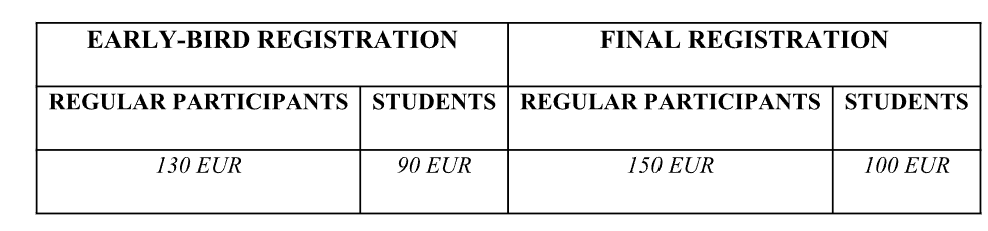
Fees will include conference pack, book of abstracts, lunches and coffee breaks